Staying is the part nobody prepares you for
There is a version of the founder story everyone knows: build the company, sell the company, ride off. Mine went differently, twice.
I founded Top Line Group in Bemidji, Minnesota in 2009 and spent a decade building it into an automotive lighting business with a portfolio of brands. In 2019 I sold it to TRS and stayed. In 2020 I co-founded Driven Lighting Group, the platform that combined our lighting brands under one roof. In 2021, through a sale process run by Kian Capital, DLG sold to Clearlake Capital-backed Wheel Pros, and I stayed again. Through my time with Wheel Pros I have worked on the corporate side as Vice President of Performance Marketing, running paid advertising and the other marketing towers for more than sixty brands. For the past year I have been focused back on the lighting business as Senior Vice President of DLG, running Product, Marketing, and B2C, and supporting every other team in the company.
So I have lived the transition this essay is about twice: once from sole founder to leader inside a platform, and once from platform co-founder to executive inside a portfolio many times that size. The lessons below are the ones I would hand any founder about to sign, and any investor deciding what a staying founder is actually worth.
What the acquirer actually bought
Here is the mental shift that matters most, and the one founders resist: the buyer did not buy you. If they did, both sides made a mistake.
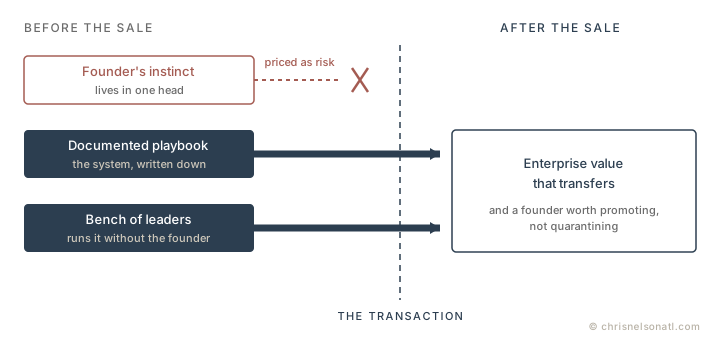
A business whose value lives in the founder's instinct is a business with a discount attached. Every serious buyer prices that risk, and every good banker works to prove it is not there. What a buyer pays for, and what they should be buying when the founder stays on, is two things: a documented, repeatable operating system, and a bench of leaders who run it without waiting on the founder.
That means the real work of the transition starts years before the transaction. Every process that lives in your head is enterprise value you have not captured yet. Converting instinct into system, targets, and owned territories is not bureaucracy. It is the act of making your company buyable, and it is the difference between a founder the acquirer needs to quarantine and a founder the acquirer wants to promote.
By the time we sold in 2021, the operating system I described in the first essay in this series, aces in their places, ownership transfer, every leader laddered to the math, was running the portfolio day to day. That is what changed hands. Which is exactly why there was still a job for me on the other side, and a bigger one.
The playbook is the product
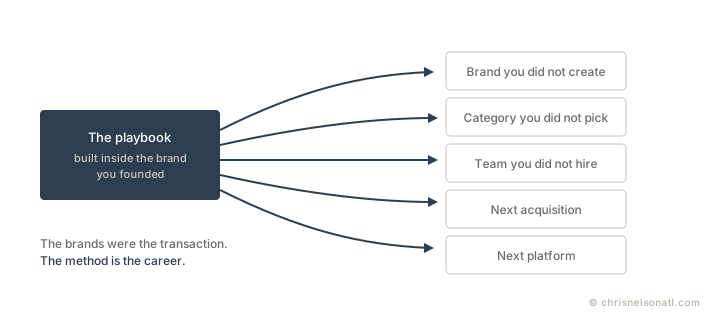
Once you are inside the acquirer's portfolio, your value flips. Before the sale, the playbook existed to run your business. After the sale, the playbook IS the business you bring. The brands were the transaction. The method is the career.
A portfolio acquirer has one structural question about any staying founder: does this person's success repeat outside the thing they built? The founders who thrive after a sale are the ones who can lift their system out of its original container and apply it to brands they did not create, categories they did not pick, and teams they did not hire. That is the difference between being an asset that came with the deal and being an operator the platform can deploy. For me that test was literal. The corporate chapter meant applying the method to sixty-plus brands I did not create, before returning to lead the business I co-founded at a higher level.
So the practical advice for a founder who intends to stay: write the playbook down as if someone else will have to run it, because someone else will. The discipline that feels unnecessary when the company is yours becomes your proof of value the day it is not.
Build the bench or stay trapped
The second structural question an acquirer asks is quieter, and it decides your ceiling: what happens to the business if we give this founder a bigger job?
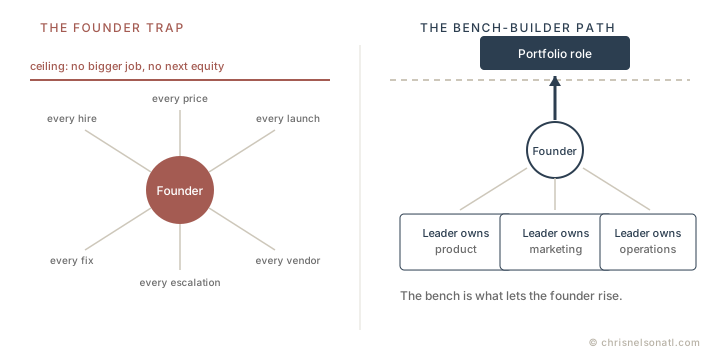
If the honest answer is that the original business wobbles, you will never get the bigger job. The founder who stays the single point of decision has built a trap and locked themselves inside it. They cannot be promoted, cannot take on a second brand, and cannot credibly ask for equity in the next deal, because their value is pinned to one seat. I have watched capable founders stall exactly here, and it is self-inflicted.
The exit from the trap is the bench. Transferring real ownership to leaders, with the expectations, authority, tools, and skills that make accountability stick, is what frees a founder to rise. It also does something subtler: it converts your value story from "irreplaceable operator," which frightens buyers, into "builder of leaders," which attracts them. The strongest position a staying founder can occupy is designed the engine, trained the crew, available for the next engine.
Scale is a different sport
The third lesson is the one I underestimated. Going from running your own P&L to operating inside a large portfolio is not a bigger version of the same game. It is a different sport.
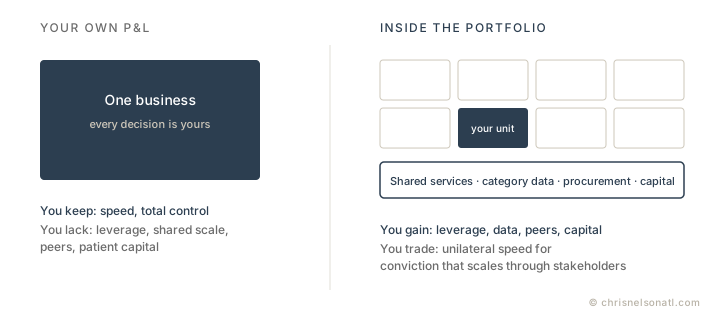
As a founder, you own every decision and every consequence, and speed is your advantage. Inside a portfolio, you gain things a founder can never buy alone: procurement leverage, shared infrastructure, category data across dozens of brands, peers who have solved problems you have not met yet, and capital that lets you make bets a bootstrapped company cannot. I have learned more about operating at scale in the past five years than in the fifteen before them.
What you trade is unilateral speed. Decisions have stakeholders. Capital has a process. Priorities compete with businesses that are not yours. The founders who fail the transition read this as loss and fight the structure. The ones who succeed learn to move inside it: build the case, align the stakeholders, and use the platform's weight instead of resenting it. The skill of the founder is conviction. The skill of the portfolio executive is conviction that scales through other people's yes.
The founder who stays is a career, not an epilogue
Most writing about founders treats the sale as the last page. For the founder who stays, it is a promotion with the hardest interview you will ever do: years of diligence on whether your success was you or a system.
Build so the answer is the system, and the bench, and a founder who can do it again at a larger scale. That is what an acquirer is actually buying when they keep you. Twice now, it is what mine did.