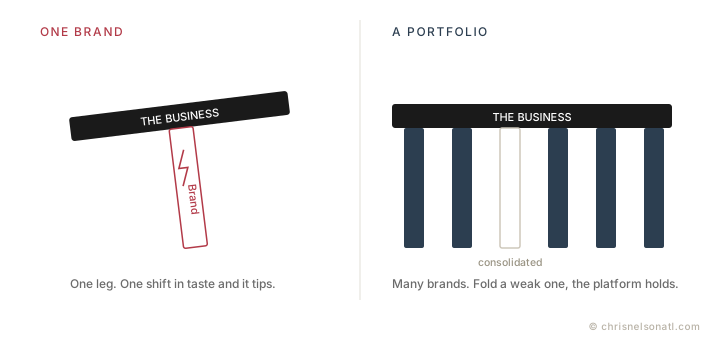
When I started what became Driven Lighting Group, I named my first company Top Line Group on purpose. Not Top Line, the brand. Top Line Group. I knew before I built anything that I wanted a group of brands, because I have never believed a single company can be all things to all people. Bet everything on one name and you have built yourself a trap. Tastes move, a competitor undercuts you, a channel shifts, and the one thing you are becomes the one thing the market leaves behind.
So the plan was broader from day one: a group of premium brands working in concert to serve as many buyers as possible across different niches. That instinct, more than any single product, is what eventually became a portfolio of more than sixty brands in automotive lighting and accessories, and what carried it to a sale through Kian Capital in 2021.
This is how the system actually worked.
The thesis: own the buyer's final two
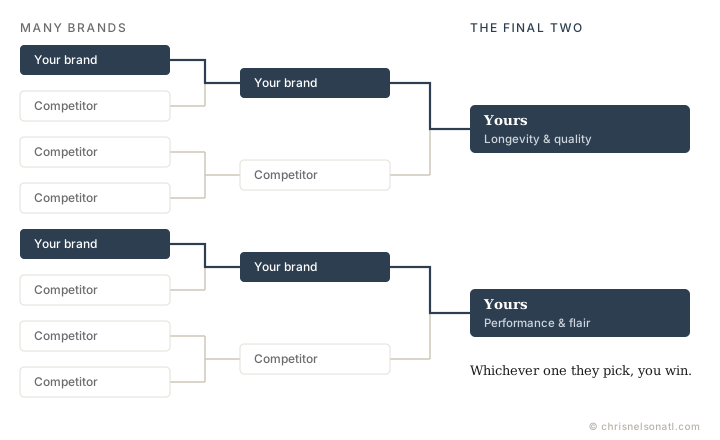
Every real purchase decision ends the same way. People comparison shop. They read the tests, they read the reviews, and they narrow the field down to a shortlist. By the time a serious buyer is deciding, they are usually choosing between two options they consider the best.
I wanted to own that moment. Not by tricking anyone, and not by being the only option on the shelf. By being the best two.
The strategy was to build competing brands under one roof that were each genuinely better than everything else in the category, so that when a shopper got down to their own personal top two, both were almost always mine. Whichever one they picked, the customer won and so did I.
The part that makes this work, and the part most people get wrong, is that it was never fake choice. The brands had real and different value propositions. One was built for longevity and quality. The other was built for performance and flair. People want different things, and I was not going to insult them by dressing up one product as two. They were two distinct, legitimately excellent answers to the same need, and the buyer got to choose which version of "the best" suited them.
This is category strategy, not a monopoly. The products earned their place at the top because they performed. In our own testing they outran competing products in the segment by a wide margin across the metrics that mattered. That performance is what made them easy for buyers around the world to keep considering. The portfolio strategy simply made sure that when the shortlist formed, it formed around us.
From one play to a portfolio
Owning the final two in a single niche is a tactic. Turning it into a repeatable portfolio is the actual work.
I built several niche brands the same way, and I watched closely to see which ones were winning. At one point, through acquisitions as well as internal launches, we had nearly ten brands operating together. The same strategy held, but only because we already had the thing that makes it possible: a leading distribution and marketing position across every major social platform.
That platform is the moat. It is the same reason a Target or a Walmart can launch and test competing private brands and still control the value: they already own the audience and the shelf. We owned the audience. That captive attention is what let us introduce, test, and promote competing brands while giving buyers true choice instead of forcing them down one path. The persuasion was honest. They really could pick whichever version of the best they wanted.
The other half of running a portfolio is the discipline most founders never develop: consolidation. Not every brand is a winner. When you merge multiple businesses you see it immediately. The best ones grow and take over, and if you are honest about the numbers you concede the rest. If Brand A grows to five times the size of Brand B while both consume the same time and capital, you stop propping up Brand B, you fold it, and you redeploy into the next variation.
That is the mindset shift. You have to treat a business and its brands as if they are alive: aging, dying, and being born again. You never settle on one thing. And you stay vigilant, because the market is a jungle. There is always something out there trying to take your share, and the only defense is to keep pushing and innovating to hold your position.
The operating system that scales beyond you
Early on, all of this lived in my head as instinct. That does not scale. By the time you are running ten brands and making consolidate-or-iterate calls, other people have to be executing the judgment, not waiting on you to make every call. Building that capacity comes down to two beliefs I hold strongly.
The first is aces in their places. Find the right person for the task, never the task for the person. A business fails when you find a good person and then invent a role around them. Decide what the business actually needs to succeed, then go find the right person for that need. This is the classic founder-led pitfall: a capable founder assumes everyone can be as multi-talented as they are, so they accidentally build roles around people and hire inward when the right talent is not on the team. I learned this by doing it both ways. Sometimes you have to recruit the missing expertise from outside, and you have to be self-aware enough to admit when you do.
The second is faster alone, farther together. Building a team is not enough. You have to empower it, and most importantly you have to transfer real ownership and accountability to every member. Without that, people never get the foundation of purpose that makes them act like owners, and a big team becomes an anchor on your growth instead of propulsion for it.
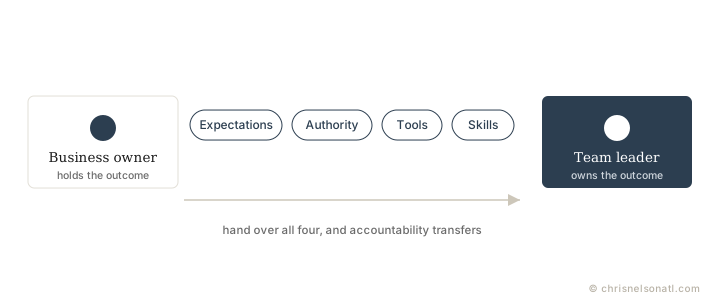
On top of those beliefs sits structure, and this is where most entrepreneurs fall down, usually because they lack the self-awareness to realize they do not know what they do not know, so they never go looking for the missing pieces.
Every department needs a leader who owns their territory. Depending on the size of the company that is a manager, a director, or a vice president, but the principle is the same: at any given moment, everyone should know who owns a given situation. Most businesses below the enterprise level slice cleanly into five territories: Product, Marketing, Operations, Sales, and Finance.
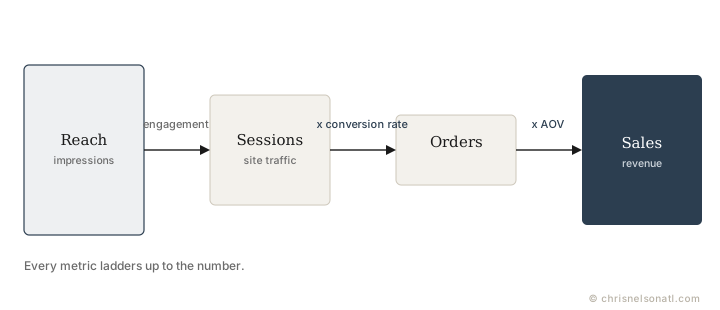
Then you tie it to the math. Every leader has to know the revenue target and exactly how their function ladders up to it. Revenue equals a specific number, which requires this much B2C sales, this much wholesale, this many orders shipped per day, this many launches per month, this much traffic converting at this rate. You build a top-down target map where each person's accountability is a KPI, and those KPIs add up to the revenue goal. When you miss, you can see precisely which function fell short. When you beat the target, you can see which team overdelivered and use that as a signal for where to invest next.
A few of the KPI frameworks I rely on:
- In B2C ecommerce, sessions, average order value, and conversion rate are the primary metrics, sitting on top of a structural layer that drives them: domain authority, backlinks, keyword rank and visibility, AI visibility, online sentiment, page load speed, and bounce rate. Dialed in, you can read these by traffic source and optimize where the most valuable traffic comes from. For conversion rate I like to see between 1.15 and 1.6 percent depending on promotion and season, with a stretch target above 2 percent.
- In marketing, I look at reach, efficiency, and APOR, Advertising Percent of Revenue. APOR cuts through the noise of the standard metrics and tells me how effective the marketing strategy truly is.
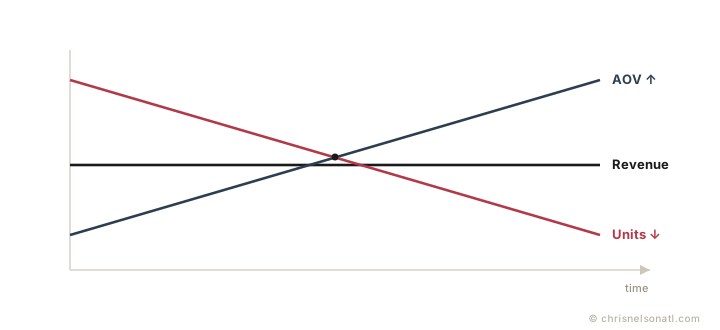
- In product, units matter as much as sales. Unit trends tell the real story of a product's popularity, especially after a price change. Raise price and revenue can rise while units quietly erode underneath. And defect rate deserves far more attention than it gets, because it is a hidden profit hole: not just a product cost, but an operational cost and a hit to brand reputation.
Read the math, not the vanity metric
One discipline I built into every brand: never let an average carry the story alone. Average order value can climb while the business underneath it is shrinking, because when you lose your most price-sensitive buyers, the average rises on its own. It is the arithmetic shadow of a mix shift, not a win. So we always reported AOV next to order count and category-level unit volume. A rising average sitting on falling units is a warning, not a victory lap, and that one reporting rule surfaced problems that revenue alone would have hidden for months.
That is the whole philosophy in miniature. Build brands that genuinely deserve to win. Own the buyer's shortlist by being the best two, honestly. Run them as a living portfolio and consolidate without sentiment. Put the right people in clear territories, hand them real ownership, and tie every one of them to the math. Then watch the numbers closely enough to see the truth behind the headline.
That is what turns a collection of brands into a system. And a system, unlike a founder's instinct, is something a company can keep running long after the founder stops making every call.