The quarter the funnel moved
Every e-commerce operator I talk to felt some version of the same thing over the past year: organic traffic softening, conversion rates sliding, and nothing on the site to explain it. The product pages did not change. The ad accounts did not change. The market did not collapse. The numbers moved anyway.
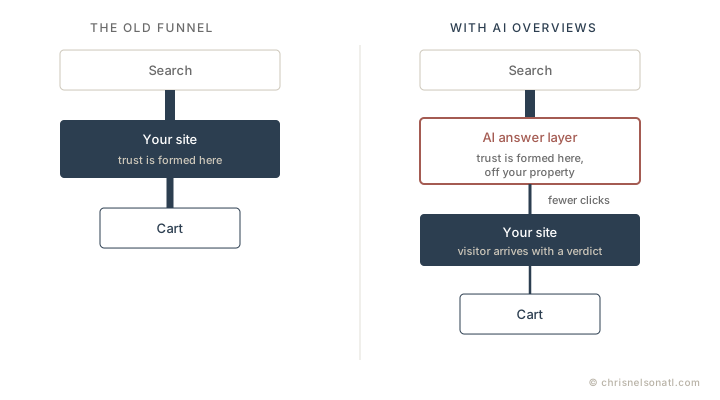
What changed was the search results page. Google's AI Overviews now sit on top of a growing share of queries, and field studies in early 2026 measured roughly 38 percent fewer organic clicks on queries where an AI Overview appears, with zero-click searches climbing past two thirds of all queries. That is not a rounding error. That is the top of the funnel being rebuilt in front of us, by someone else.
The traffic loss is the part everyone talks about. It is not the part that worries me most.
The question you never see
Somewhere in your customer's path to a considered purchase, there is a question you never see in any report: is this brand legit?
Shoppers have always asked it. They used to answer it on your site, reading reviews, checking the return policy, looking for a phone number. Now Google answers it for them, in a paragraph, before they ever click. And the AI assembles that paragraph from whatever sources it can find.
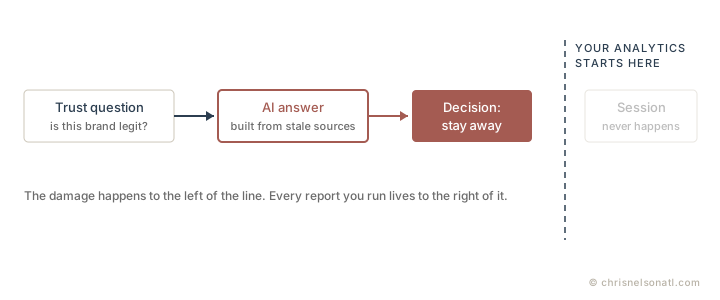
Inside my own portfolio, I did what a first-time customer would do. I typed the trust questions into Google, the "is this brand legit" and "is this brand trustworthy" searches, and read what came back. The AI answer was built on years-old reviews from a low-volume third-party site. Not fraudulent, not defamatory. Just stale, thin, and frightening to somebody about to spend several hundred dollars with a brand they had never bought from.
Here is the operator's problem: that customer never shows up in your analytics. They did not bounce. They never arrived. Your dashboards start at the session, and this damage happens before the session exists. Which means every diagnosis you run inside your own data will point you at the wrong things.
Why category-specialty retail gets hit hardest
If you sell in a niche category, and especially if your average order runs into the hundreds of dollars, this hits you harder than it hits mass retail, for two reasons.
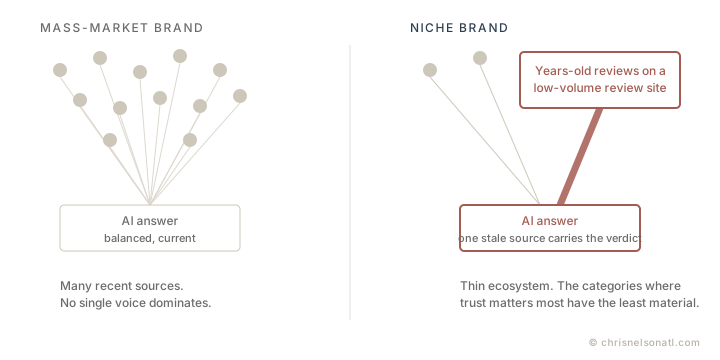
First, considered purchases generate trust questions. Nobody googles whether a phone charger brand is legit. They absolutely google it before putting an expensive, safety-relevant, or install-it-yourself product in the cart. The more considered the purchase, the more of your funnel runs through the answer layer.
Second, niche categories have thin content ecosystems. A mass-market brand has thousands of recent sources for an AI to draw from, so no single stale source dominates. A category-specialty brand might have a handful. When the pickings are thin, one outdated review site can become the authoritative voice on your trustworthiness, and the AI will present it with total confidence.
That is the structural trap: the categories where trust matters most are the categories where the AI has the least to work with.
The operating sequence: reputation, then conversion, then organic
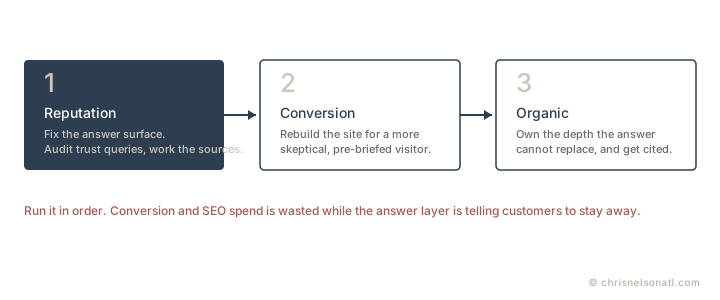
When performance breaks this way, the instinct is to attack the visible metrics, run a conversion audit, refresh the SEO roadmap. I think that order is wrong. The sequence I run is reputation first, conversion second, organic third.
Fix the answer surface first. Search your own trust queries the way a stranger would, in a clean browser, on a phone. Read every AI answer about your brand. Inventory the sources it cites. Then work those sources directly: refresh what is stale, respond where response is possible, and earn current, credible coverage that gives the AI something better to assemble. You cannot edit the AI's answer, but you can change the material it builds from. Treat the answer layer as a surface you operate, with an owner, a cadence, and a target, not as weather.
Rebuild conversion for a more skeptical visitor. The shoppers who still click through have already read a summary about you. Some arrive pre-sold and convert better than classic organic traffic. Others arrive carrying an objection the AI handed them. Your site has to answer that objection on the page: recent reviews, visible guarantees, real support channels, proof that the brand is alive and accountable. A product page built for 2022 traffic does not convert 2026 visitors.
Then rebuild organic around what the answer cannot do. An AI Overview can summarize whether you are trustworthy. It cannot confirm fitment for a specific application, walk a customer through an install, or compare configurations at the depth an enthusiast wants. Deep category expertise is the content the answer layer cannot replace, and increasingly it is also the content it chooses to cite. In a niche, the operator with the deepest current expertise gets to be the source the AI quotes.
Run the sequence in order. Conversion and SEO work are wasted spend while the answer layer is telling customers to stay away.
The part no dashboard will tell you
Here is the uncomfortable finding from doing this work inside a real business: nothing in the reporting stack flagged it. The reports looked fine on paper. The problem surfaced because I walked the customer's actual path, question by question, and then sat with the team layer by layer asking one thing: who owns the answer to "is this brand trustworthy?"
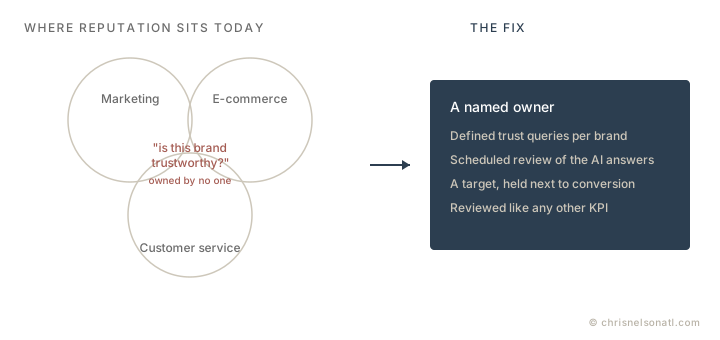
Nobody owned it. In most companies, nobody does. Reputation sits in the gap between marketing, e-commerce, and customer service, and the AI answer layer turned that gap into a revenue leak.
The fix is not a tool. It is an operating decision: name an owner, define the trust queries that matter for every brand you run, review what the AI says about you on a schedule, and hold the number up against conversion like any other KPI. This is the same discipline I wrote about in building a portfolio operating system: clear territories, real ownership, everything laddering to the math. The only new part is what it points at.
The read
Search is turning into an answer layer that mediates trust between brands and customers. For category-specialty e-commerce, that layer now sits in front of the funnel, and it is being assembled from sources most operators have never audited.
The operators who win the next few years will treat the AI answer as an operated surface: owned, measured, and worked, the same way a prior generation learned to operate the search results page itself. The ones who keep optimizing only what their analytics can see will keep solving the wrong problem, one conversion audit at a time.