In late 2020 we had a problem that money could not immediately fix. Like most consumer companies in the COVID era, our supply chain had slipped. New products we had promised customers were delayed by months, not weeks. Orders were paid for. Containers were not moving. And every morning the customer service queue filled up with people who had trusted us with their money and were getting silence in return.
The standard playbook for that moment is an apology template, a ticket queue, and maybe a coupon code. We did something different. We gave every customer service agent and every marketing team member who touched customers what we called the $100 rule: the authority to do anything, on the spot, that costs $100 or less to solve the problem in front of them. No approval. No escalation. No ticket sitting in a manager's queue overnight. However they saw fit.
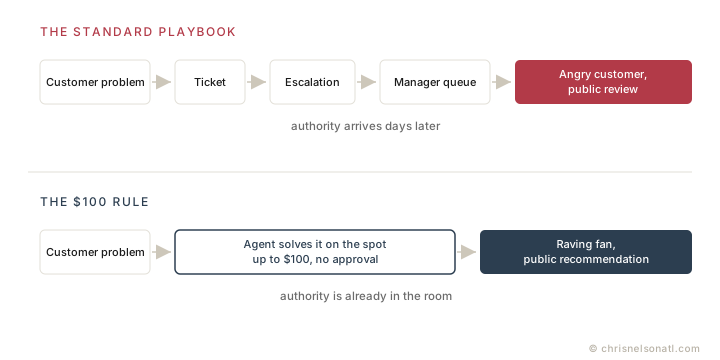
They refunded shipping. They sent free product a customer could run right now while waiting for the delayed part. They took $100 straight off paid orders as an apology. They added expedited shipping for the day the backordered product finally landed. Instead of an ocean of bad reviews warding off every shopper who researched us, we had happy customers recommending us online, in reviews, and in the forums where car enthusiasts talk to each other. Dozens of angry customers became dozens of raving fans. When the product arrived and passed QC, the period that followed was one of the fastest growth stretches we had, from late 2020 through the sale of the business to Clearlake Capital-backed Wheel Pros a year later.
Here is the part that matters for operators: that outcome was not a warm story about being nice. It was an exchange rate.
The exchange rate
Every dollar of customer experience you cut does not disappear from your cost structure. It transfers to paid acquisition, at a worse rate.
Run the math the way a CFO would. The $100 an agent spent saving a customer bought a retained buyer, a positive review, and a story that customer told in a forum thread that outranks your ads. Now price the alternative: replacing that customer with a new one through paid media, at whatever your category's acquisition cost runs, into a review environment that customer just made worse on the way out. A sticker pack in the box costs less than a retargeting click. A five-star review is the only ad you never pay for twice. A generous return policy is retention spend, and retained revenue is the cheapest revenue a consumer business ever books.
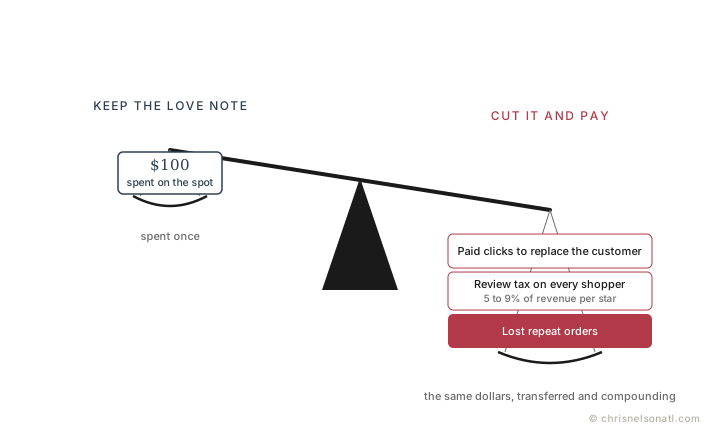
The research puts hard numbers on this exchange rate. A Harvard Business School study by Michael Luca found that each one-star change in a Yelp rating moves revenue 5 to 9 percent. Northwestern's Spiegel Research Center found that displayed reviews lift conversion by up to 270 percent, and by even more for higher-priced products, exactly the premium end where enthusiast brands live. Read those two findings together and a negative review is not one unhappy customer. It is a tax on the conversion rate of every shopper who reads it, applied to traffic you are already paying for.
This is what "customer experience is a growth function" means mechanically. The line items look like costs because their return shows up in someone else's column: in organic traffic, in repeat rate, in the conversion lift of a 4.8-star average, in the marketing budget that does not have to work as hard. Cut them and each cut books a saving immediately and an expense later, somewhere else, larger.
The spiral
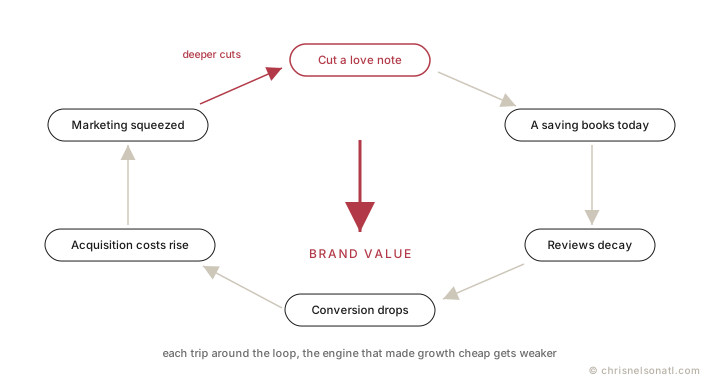
You can watch what happens when a company optimizes without a counterweight. It does not matter who owns it. Founder-led companies do this to themselves. Public companies do it quarterly. Any growing or mature company can fall into the trap of treating the business as numbers on a page, where anything without a direct, attributable ROI is a candidate for the knife.
The candidates are always the same, because they are the line items that cannot defend themselves in a spreadsheet. The branded packing tape. The free sticker pack in every order. The service staffing that keeps phone and email response fast. The warranty and return policies that give people the benefit of the doubt. Each one goes, and each one books a saving. Then the reviews start to decay. Marketing has to work harder for the same result with fewer resources, which deepens the cycle. One bad review becomes 2,000. And at the end of it, the brand is unrecognizable: people do not care how cool your product used to be if the community is full of stories about who you became. The things that made the company feel personal and unique were the things that gave the brand its value. They were the growth engine wearing a cost center's name tag.
The counterweight
The defense is a single question, asked everywhere, with real authority behind it: what is best for our customers?
A product idea. A website change. A shipping policy. A customer service strategy. Run every one of them through that lens first. Not because it is nice, but because of the exchange rate. The question is how you find the investments that compound before a spreadsheet can see them.
And it points at the sharpest competitive weapon available to a consumer brand:
Doing what your customers want that your competitors are not willing to do.
Giants struggle here. A company moving mountains cannot stop to write love notes, and the small, scrappy company that invents new ways to be personable and connected takes the fringes while the juggernaut watches them burn. The giants that stay beloved are the ones that institutionalize the love note instead of outgrowing it. Ritz-Carlton famously authorizes every employee to spend up to $2,000 to solve a guest's problem without asking anyone. Our $100 rule was the same idea at our scale. The number is not the point. The authority is.
What the exit taught me
The proof that this survives contact with real financial discipline is the period the numbers come from. The stretch when we ran the $100 rule, kept the packaging, kept the service levels, and kept asking the customer question sat inside a private equity hold that ended with revenue up 5x and EBITDA up 4x over 3.5 years, and a sale to a strategic acquirer. Customer obsession did not fight the investment math. It was the investment math. The experience line items were protected the way you protect any asset that compounds.
In 2022, SEMA published my view of this in a sentence I still stand behind: the reason to be in business is to help people and to solve a problem, and if we are not actively making people's lives better, I don't think we're doing a good job.
What four more years of operating taught me is what that sentence was missing. In 2022 I framed customer experience as a belief. Beliefs are fragile. They last exactly as long as the person holding them stays in the room, and companies change rooms: new owners, new CFOs, new budget cycles, new pressure. The 2026 version is that customer experience has to be defended as balance-sheet logic, not preached as culture. You protect the spark by teaching finance why it is there. When the people who own the spreadsheet understand the exchange rate, the sticker packs survive the budget meeting without you.
The $100 rule ran for about a year. It remains the cheapest money I have ever spent.